Meet Our Consumer Protection Attorney
Sam Mollaei, Esq.
Sam Mollaei is the Founder and Managing Attorney of Consumer Legal Support. He is a California-admitted attorney and a graduate of Southwestern Law School and UCLA.


Did you know motor vehicle accidents cost US citizens around $340 billion in a single year? This also includes medical expenses, lost wages, vehicle repair costs, and much more.
It works out to roughly $1,035 for every person in the U.S. That’s why learning how to calculate your car accident settlement makes real sense. (Source: NHTSA, 2019 data)
Are you wondering how insurance companies decide what your car accident settlement is worth? Most people expect a clear formula, then feel confused when settlement offers arrive.
Many people stare at a low offer and ask, “How did they even calculate this?” Insurers use structured methods that rarely feel intuitive or fair.
The best way to get fair compensation is to have proper knowledge about damages, negotiations and documentation.
Let’s explain how to calculate a car accident settlement so you’re not guessing!
Short answer: There is no single formula for a car accident settlement. Insurers usually start with your documented economic damages, such as medical bills, repairs and lost wages, add an estimate for pain and suffering, then adjust for fault and policy limits. Online calculators and multipliers give rough estimates only.

| Factor | What it covers | How it is estimated |
|---|---|---|
| Economic damages | Medical bills, vehicle repair or replacement, lost income | Receipts, invoices and pay records |
| Non-economic damages | Pain and suffering, loss of enjoyment of life, emotional distress | Multiplier or per diem method (rules of thumb, not law) |
| Punitive damages | Punishment for reckless or intentional conduct | Only in extreme cases |
| Fault | Your share of fault reduces what you can recover | California uses pure comparative negligence |
| Insurance limits | Available coverage can cap what an insurer pays | California minimum coverage explained |
A car accident settlement resolves your accident claim without going to court. Instead of a jury decision, you and the insurance companies agree on fair compensation.
Settlement covers economic damages like medical bills and vehicle repairs. It also includes compensation for non-economic damages such as pain and suffering.
A settlement offer aims to fairly cover losses from the accident you suffered. A large number of personal injury cases never reach trial since the settlement is cheaper, and quick.
Insurance companies break your loss into specific categories when they calculate value.
Understanding these helps you estimate what your settlement might reasonably include.
These are the damages that come with receipts and invoices.
In this category, your pain and lifestyle changes after the car accident gets the focus.
In a car accident settlement, economic damages are pretty easy to calculate. But, the calculation of non-economic damages require careful negotiation.
These damages are not for compensating injury victims straightaway. It punishes the at-fault driver and discourages any similar behaviour in future.
If the conduct goes beyond ordinary negligence, punitive damages come into the scene. Its focus is reckless or intentional behavior that endangers others.
Punitive damages may apply when an accident involved:
Not every car accident case qualifies for punitive damages. Most insurance claims never include them at all.
Courts reserve these damages for severe cases with clear evidence of misconduct. Insurance companies often fight punitive damage claims aggressively.
They argue these damages fall outside standard insurance coverage. That’s why punitive damages usually require legal involvement and court approval.
If awarded, punitive damages can significantly increase total settlement value. However, they are rare and should never be assumed during settlement calculations.
Honestly, there’s no constant formula to calculate this. Because every car accident is different. Things depend on specific facts, injuries, and financial losses.
That’s why insurance companies use different methods to estimate settlement value.
Know these methods properly to estimate your potential settlement more realistically. It also prepares you for negotiations with insurance adjusters later.
The multiplier method helps insurers estimate pain and suffering damages. It is a common rule of thumb in negotiations, not a legal formula.
It takes your documented economic damages and multiplies them by a number. That number usually ranges between 1.5 and 5 based on injury severity.
| Injury severity | Typical multiplier range |
| Mild, quick recovery | 1.5 – 2 |
| Moderate injuries with ongoing treatment | 2 – 3 |
| Severe or long-term impact | 3.5 – 5 |
Hypothetical example (an illustration, not a prediction of your result):
If your economic damage is $20,000, and we multiply it by 3, the pain and suffering damage compensation stands at $60,000.
The per diem method calculates pain and suffering differently. It assigns a daily dollar amount to physical pain during recovery.
That daily rate is multiplied by the number of recovery days. The daily amount often reflects lost earnings or a reasonable pain estimate.
Hypothetical example (an illustration, not a prediction of your result):
A daily rate of $200 over 150 recovery days equals $30,000. It works best when injuries have a clear recovery timeline. Permanent injuries usually require the multiplier method instead.
If you’re trying to figure out what your claim is actually worth, you’ll probably run into those online settlement calculators.
They’re basically just “math-fying” your medical bills, lost wages, and how bad the injury was to give you a quick number.
They’re great for a “ballpark” estimate when you’re just starting out, but honestly? Don’t take that number as gospel. The problem is these calculators are pretty robotic.
They use a standard formula that totally misses the human stuff; like the emotional stress you’re dealing with, any future doctor visits you’ll need, or the fact that lifestyle has taken a hit.

Fault really matters when you’re calculating a car accident settlement. If the at-fault driver caused the accident, their insurance should cover damages.
However, shared fault can reduce your settlement amount significantly. California follows a “pure comparative negligence” rule, so you can still recover compensation if you are partly at fault, but it is reduced by your percentage of fault.
Your settlement amount might be reduced by the percentage you’re deemed at fault. Have a look at the table to get an idea:
| Your fault % | Settlement reduction |
| 10% at fault | 10% reduction |
| 25% at fault | 25% reduction |
| 50% at fault | 50% reduction |
Insurance companies often push fault arguments to reduce payouts. That’s why solid evidence and documentation help support your settlement negotiation.
Strong settlement outcomes almost always start with strong documentation. Insurance companies often interpret limited documentation as weak evidence, and offer less.
Here’s what usually makes a difference when you calculate your personal injury settlement:
Medical and financial records
Accident and property evidence
Pain and non-economic effects
Insurance companies often use these documents to justify settlement offers. Don’t miss out on any pieces, as it will reduce the compensation rate and make the negotiation tough.
Insurance companies often make initial settlement offers that feel low. They do this because early offers set expectations and reduce their risk.
Don’t accept the first offer too early. Because of this, you may miss fair compensation. Focus on these principles for a better negotiation:
Emphasize the proofs, not emotions
Respond with a counteroffer
Not every car accident claim requires legal representation. Yet, hiring a professional personal injury lawyer is often beneficial, if your settlement negotiations reach an impasse.
Attorney involvement can help you:
Many personal injury lawyers offer a free consultation before you commit financially. With a consultation you can understand the below things:
Experienced counsel often means more leverage with large insurance carriers.
Accepting too soon is one of the biggest mistakes in car accident cases. Slow, careful review before acceptance almost always leads to better results.
Here’s a clear checklist before accepting any offer:
| Step | What it means |
| Review payouts | Ensure all medical expenses are included |
| Future treatment | Confirm future medical costs are factored |
| Non-economic damages | Ask if pain and suffering was calculated |
| Lost wages | Double-check lost income records and estimates |
| Property damage | Make sure vehicle repairs are fully covered |
If your offer doesn’t reflect these items, push back. Ask for written explanations on every deduction or exclusion.
If negotiations fail to improve your estimated payout, options remain. A personal injury lawsuit may be needed to secure fair compensation.
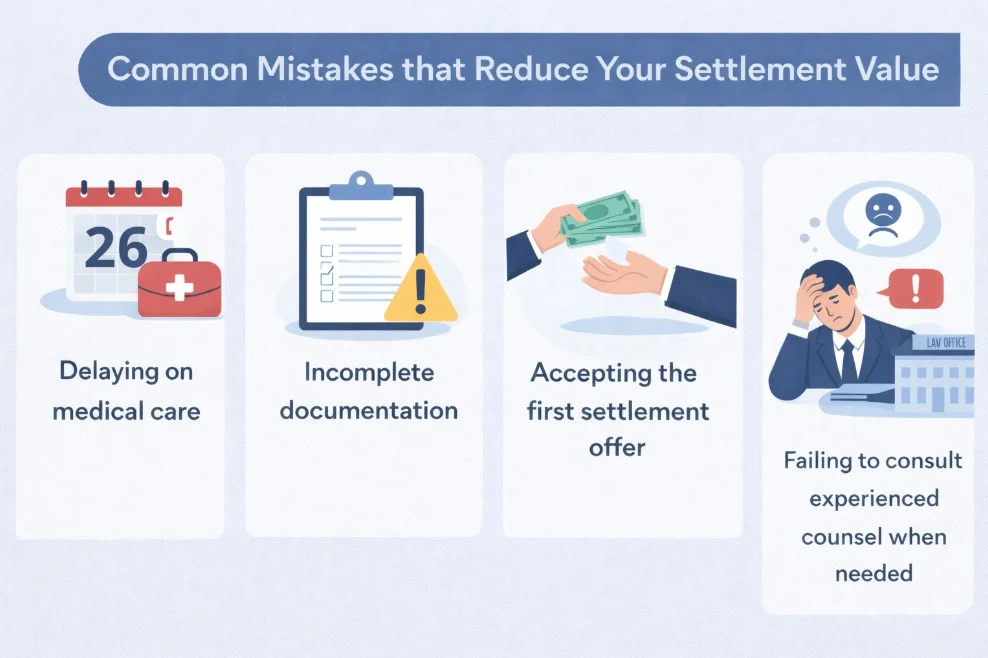
A surprising number of people unintentionally weaken their own claims. These mistakes often show up in insurer arguments later. Let’s have a look at some common mistakes:
Want a second opinion on an offer? Request a free case review and we will connect you with an attorney. Related reading: how settlement calculators work, how pain and suffering damages work and the California statute of limitations for car accidents.
The National Safety Council estimates the average economic cost of a disabling motor-vehicle injury at about $174,000 (2024 estimate), counting medical expenses, lost wages and other losses. Your own losses may be higher or lower.
Shared fault, limited insurance coverage, and weak medical documentation reduce settlements most. Delayed treatment and missing records also give insurers reasons to pay less.
A settlement calculator gives a rough estimate, not a guaranteed settlement value. It helps you understand insurance math, but it cannot reflect every detail of your case.
The multiplier method multiplies your documented economic damages by a number that reflects injury severity to estimate pain and suffering. The range is a rule of thumb used in negotiation, not a legal formula, so real outcomes vary.
Yes. California follows a pure comparative negligence rule, so your compensation is reduced by your percentage of fault rather than barred entirely.
Not every claim requires one, but an attorney can help if the insurer disputes fault, undervalues your injuries or makes a low offer. You can request a free case review to be connected with an attorney.
Sources: NHTSA, economic cost of motor vehicle crashes (2019 data) and National Safety Council, Injury Facts. Multipliers and per diem rates are rules of thumb, not legal formulas, and every claim is different. This article is general information, not legal advice.
Car accident settlement is no more a thing of hassle. Just learn the basics (damages, documentation, and insurance company methods), and you’re already halfway there.
Don’t forget that this isn’t just about the medical bills and your missed shifts. The stress, the physical pain, and the way this has messed with your daily life actually count for something too.
My advice? Take a beat and get all your records organized. When you talk to them, stick to the facts and the evidence rather than getting heated.
Your story, injuries, and losses deserve a settlement that reflects reality and sometimes persistence.



Sam Mollaei is the Founder and Managing Attorney of Consumer Legal Support. He is a California-admitted attorney and a graduate of Southwestern Law School and UCLA.
 Call (424) 866-0079