Auto Accident Settlement Calculator to Know Your Case Worth
Let me guess why you’re here. The accident is over, your car might still smell like airbags, your body hurts in places you didn’t expect.
And now you’re wondering what all of this is actually worth. Not in a dramatic sense. In a practical one. Medical bills are stacking up. Insurance companies are calling.
You’ve heard about a “settlement calculator” from someone. And now you’re trying to guess the numbers during one of the most disorienting moments of your life. That’s fair.
Let’s slow this down and talk it through in detail!
Short answer: An auto accident settlement calculator gives a rough estimate of a claim’s value from inputs such as medical expenses, property damage and injury severity. It cannot account for fault disputes, future medical needs or negotiation, so treat the number as a starting point, not a prediction of what you will receive.
Settlement Calculators at a Glance
Topic
What to know
What calculators ask for
Medical expenses, property damage and injury severity
How accurate they are
Rough estimates only, based on averages and limited inputs
What they often miss
Future medical costs, long-term effects, emotional strain and negotiation leverage
Fault
California’s pure comparative negligence rule reduces your recovery by your percentage of fault
Multipliers
Sometimes 1.5x to 5x medical bills; a rule of thumb, not a rule of law
Insurer offers
Often start below a claim’s full value, so review any offer before accepting
What an Auto Accident Settlement Calculator Really Is
An auto accident settlement calculator is a tool designed to estimate the value of a car accident claim.
Here, you’ll provide the details (medical expenses, property damage, injury severity), and it will spit out a settlement estimate.
But here’s the part most websites don’t say clearly enough: A calculator doesn’t decide your case. It approximates it. Think of it like Zillow for injury claims.
Helpful? Yes. Final word? Not even close.
A personal injury settlement calculator or accident settlement calculator is meant to give injury victims a starting point, not a guaranteed settlement amount.
It’s a snapshot based on patterns, averages, and formulas. Eventually, this is not the full story of what happened to you.
How Settlement Calculators Actually Work?
Most calculators rely on a few core inputs:
Medical bills and ongoing treatment costs
Property damage
Lost income
Type of injury and injury severity
Pain and suffering (usually estimated using a multiplier)
Percentage of fault
From there, the calculator gives an estimated settlement range. Here’s a simplified version of the logic many calculators use:
Factor
Why It Matters
Medical bills
Forms the foundation of most personal injury damages
Injury severity
Heavily influences pain and suffering
Property damage
Adds to total settlement value
Fault percentage
Can reduce your settlement amount
Duration of recovery
Signals long-term impact
That’s how a personal injury calculator or personal injury claim calculator produces numbers.
Why Calculators Can’t See the Full Picture
A calculator doesn’t see how the accident changed your sleep. It doesn’t understand chronic pain. It doesn’t account for emotional distress or anxiety after the accident occurred.
Insurance companies love calculators because calculators are predictable. Injury attorneys? We use them too; but only as a reference point.
Real settlement negotiations are shaped by things a calculator can’t measure:
Credibility of medical records
Consistency of treatment
Strength of evidence
Accident reconstruction specialists’ findings
How the injury affects daily life
That’s why the ultimate settlement amount often looks very different from an initial calculator estimate.
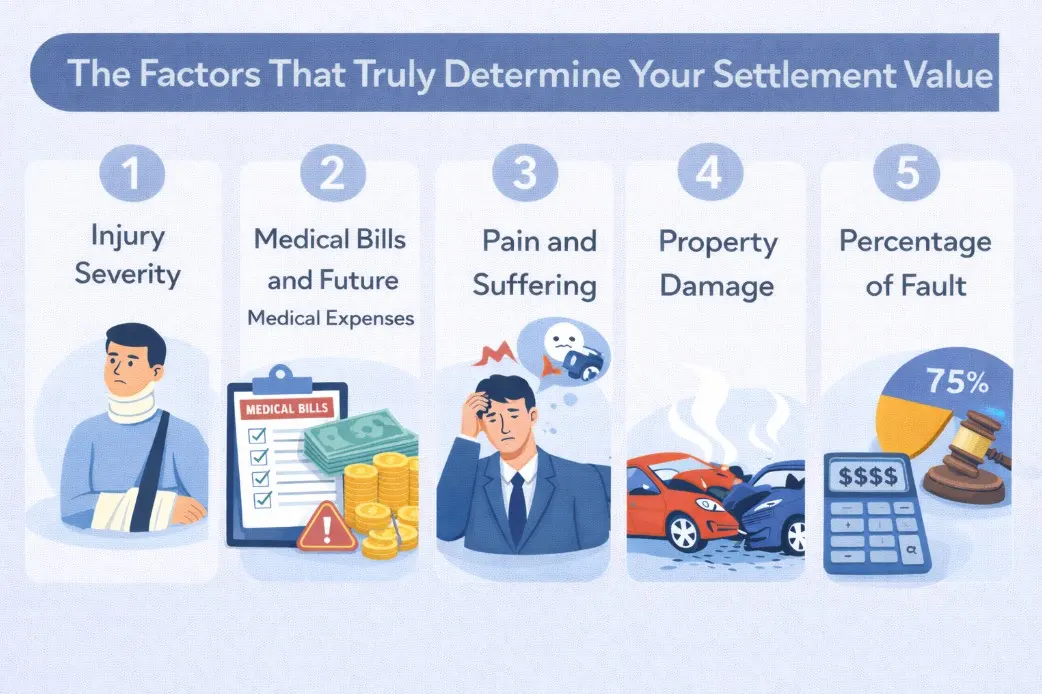
The Factors That Truly Determine Your Settlement Value
Here are the key aspects that will truly set your personal injury or auto accident settlement value:
Injury Severity (This Is the Big One)
The severity of your injuries drives nearly everything else. Minor soft tissue injuries lead to very different outcomes than fractures, surgeries, or permanent impairment.
Injury severity affects:
Pain and suffering compensation
Length of treatment
Medical expenses (current and future)
Value of your personal injury claim
Two people can have identical medical bills and wildly different settlement values based on how badly they were hurt.
Medical Bills and Future Medical Expenses
Medical bills are concrete. They’re easy to document. That’s why calculators start here. But experienced personal injury attorneys look beyond what you’ve already paid.
Future treatment matters. So does physical therapy, medication, injections, or surgeries you haven’t had yetbut likely will.
A calculator can provide an estimate. An experienced personal injury lawyer fights to make sure future costs aren’t ignored.
Pain and Suffering (The Most Misunderstood Part)
Pain and suffering isn’t just discomfort. It’s how the injury impacts your life.
Daily pain
Loss of mobility
Sleep disruption
Emotional strain
Many calculators use a multiplier (often 1.5x to 5x medical bills). That’s a rough shortcut; not a rule of law. Insurance companies often lowball this part. Injury lawyers push back.
Property Damage
Property damage is usually straightforward. Repair estimates. Vehicle replacement. Rental costs.
It adds to the total settlement, but it rarely drives the value of a personal injury case unless the damage supports how severe the impact was.
Percentage of Fault
If you were partially responsible, your settlement amount may be reduced. California follows a “pure comparative negligence” rule, so you can still recover compensation, reduced by your percentage of fault. For example:
Fault Percentage
Impact
0%
Full claim value
20%
Settlement reduced by 20%
50%
Often no recovery (state dependent)
This is one area where a calculator to get an estimate can be especially misleading. Fault is negotiable. Calculators treat it as fixed.
What Insurance Companies Do With These Numbers
Insurance companies run their own value calculators; often far more aggressive than the ones you see online. They look for reasons to:
Reduce your target settlement amount
Downplay injury severity
Classify claims as “nuisance settlement” cases
Push early settlement offers
An early settlement offer is rarely a reasonable settlement amount. It’s a starting position; whether they admit it or not.
From Calculator to Real Claim: What Happens Next
After you’ve filed a claim, the injury claims procedure usually looks like this:
Accident claim reported
Medical treatment documented
Insurance companies evaluate liability
Settlement estimate discussed
Negotiations begin
Settlement reached or lawsuit filed
A settlement calculator provides a baseline, but real claims evolve. Evidence grows. Medical records change. Adjusters reassess risk.
That’s why consulting with a personal injury attorney before making any settlement demands matters.
Why Experienced Personal Injury Attorneys Still Matter
Here’s the honest truth: A calculator doesn’t negotiate. Lawyers do. An experienced personal injury attorney looks at:
What the calculator missed
How insurance companies undervalue claims
When to push and when to hold
Whether a personal injury lawsuit strengthens leverage
This isn’t about inflating numbers. It’s about protecting injury victims from settling too early for too little.
Most injury attorneys offer a free consultation or free case evaluation because the details of your case matter more than a formula.
Real-World Examples (Why Numbers Don’t Always Tell the Story)
The examples below are for illustration only. Every case is different, and past outcomes do not predict the result of any other claim.
Here’s where calculators start to fall short.
Mark’s Story
Mark thought his case was pretty straightforward. Rear-end collision. Shoulder injury. A few doctor visits. The settlement calculator gave him an estimate just under $25,000, and at first, he figured that was probably it.
But the shoulder didn’t improve. Physical therapy dragged on, imaging showed more damage, and Mark started missing work. None of that was reflected in the early estimate.
Once everything was documented and negotiations actually began, the settlement closed closer to $60,000. Same accident. A very different reality than what the calculator showed.
Lisa’s Story
Lisa’s scenario is different from the first one. She was diagnosed with minor injuries, and the primary estimation was $9000. The faulty driver was also at the spot.
She took some short-term treatments. Without much friction, the case settled around $10,000 with an initial offer from the insurance company.
Same calculator. Two names. Two lives. Two completely different outcomes; and that’s exactly the point.
How to Use Our Settlement Calculator the Right Way
If you use an online settlement calculator, do it like this:
Be honest with medical expenses
Include all injuries caused by the accident
Treat the number as an estimate; not a decision
Use it to prepare questions, not accept offers
A settlement calculator to get clarity is smart. Using it to settle without guidance? This is pretty risky.
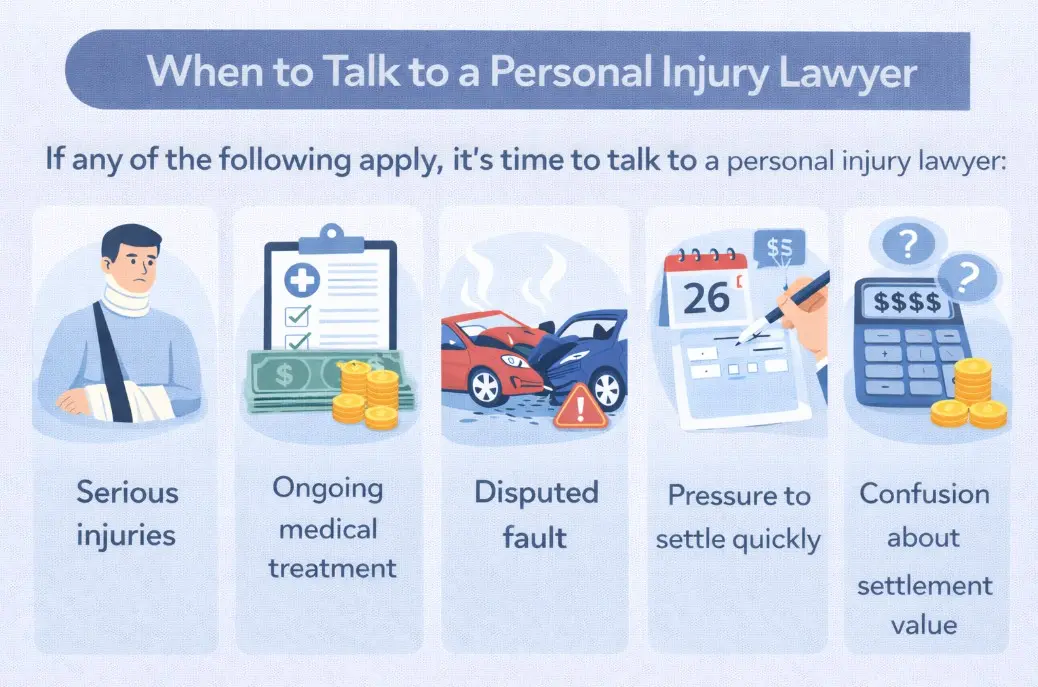
When to Talk to a Personal Injury Lawyer
If any of the following apply, it’s time to talk to a personal injury lawyer:
Serious injuries
Ongoing medical treatment
Disputed fault
Pressure to settle quickly
Confusion about settlement value
Most firms will offer a free case evaluation or free consultation.There’s no way to undo a decision when it’s final. Hence, it’s important to know your options.
How accurate is an auto accident settlement calculator?
A settlement calculator gives an estimate, not a guarantee. It’s based on averages and limited inputs. Real cases often settle higher or lower depending on injury severity, evidence, fault, and how insurance companies evaluate your personal injury claim.
Can I rely on the settlement amount a calculator shows me?
You can rely on it to give you a starting point. That’s it. Calculators don’t factor in long-term medical issues, emotional strain, or negotiation leverage. Once someone experienced actually reviews your case, that early number often changes; sometimes by a lot.
Does fault affect my settlement value?
Yes. Your percentage of fault can reduce your settlement amount. Even so, being partially at fault doesn’t always mean you’re out of options. Fault is often negotiated, especially when accident reconstruction specialists or new evidence comes into play.
Why is the insurance company’s offer lower than the calculator estimate?
Insurance companies often start low, and a first offer is frequently below a claim’s full value. Calculators don’t account for insurance tactics, policy limits or the strength of your documentation.
What information does an auto accident settlement calculator ask for?
Most calculators ask for medical expenses, property damage and the severity of your injuries, then return a rough estimate. They usually do not account for future medical needs, fault disputes or negotiation.
Can I still recover compensation if I was partly at fault in California?
Yes. California follows a pure comparative negligence rule, so your compensation is reduced by your percentage of fault rather than barred entirely.
Calculators and multipliers are rules of thumb, not legal formulas, and every claim is different. This article is general information, not legal advice.
Conclusion
A settlement calculator can be grounding when everything feels up in the air; and that matters. But your case isn’t just a number on a screen.
It’s your health. Your time. Your recovery. And the chain reaction of an accident sets off in your life. Use calculators as a reference point, not a final answer.
Ask questions. If you can, try to slow things down. Remember, before accepting any settlement, make sure you actually know what you are giving up.
It may look like a few simple questions. But, that careful conversation now can shape the outcome for years to come.
Sam Mollaei is the Founder and Managing Attorney of Consumer Legal Support, where he leads a results-driven legal team focused on protecting consumers and fighting for individuals who have been injured or wronged. His approach combines legal expertise with strategic business practices, aiming to transform the delivery of legal services in consumer protection and personal injury. s a California-admitted attorney and graduate of Southwestern Law School and UCLA, Sam has helped thousands of clients nationwide, handling cases involving car accidents, slip and falls, premise liability, and TCPA violations, all on a no-fee, no-risk contingency basis.
Receive the Compensation You Deserve for Your Car Troubles









 Call